




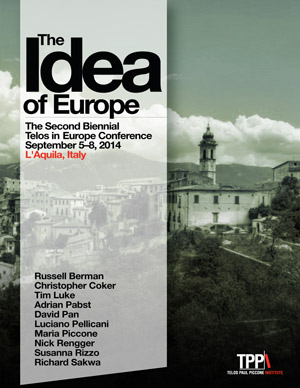
The Second Biennial Telos in Europe Conference
September 5–8, 2014
L'Aquila, Italy
The Idea of Europe
View the conference program (in PDF format)
Conference videos
Conference Outline
 For about two millennia, Europe was engaged in a struggle for global supremacy. From the unprecedented spread of Christianity via the discovery of the New World to modern colonial conquests, Europe's empires rivaled and surpassed other ancient dynasties in Persia, India, and China.
But since the end of World War I and the demise of imperial Europe, the continent's influence in international affairs has dramatically declined. This, coupled with tectonic shifts such as the changing U.S. vision of its global role and the resurgence of Asia, seems to seal the passage to a post-European phase of history.
Moreover, Europe itself is in disarray. The European Union has promised peace, prosperity, and unity-in-diversity. But in its current configuration the single market is arguably an engine of top-down homogenization, privileging the interests of both "big government" and "big business" at the expense of civil society and the civil economy that is composed of intermediary institutions and small-and medium-size enterprise.
The euro has benefitted the core countries, but it has also inflicted conflict and misery on its peripheral members. Integration has retrieved and extended the ancient Carolingian unity of France and Germany in the west. But one can also suggest that enlargement has failed to restore the Constantinian vision of a pan-European polity that includes Russia, Ukraine, and Turkey—former imperial powers that emerged from Byzantium and which are not willing to pool their national sovereignty.
What happened to the post-1989 dreams of a united Europe from Lisbon to Vladivostok as expressed in the 1990 Paris Charter of the OSCE or Gorbachev's famous notion of a "Common European House"? Is the EU a new kind of civilian power that promotes democracy and human rights by syndicating its values and legislation across the world? Or is the Union synonymous with double standards, hypocrisy, and a central diktat by an elite that is unelected and unaccountable?
Yet at the same time, the EU is perhaps one of the most ambitious attempts in history to overcome both nationalism and colonialism in the direction of a new type of polity that has variously been described as a political system sui generis, a neo-medieval empire, or a new cosmopolitan body.
Linked to this is the long-standing debate about whether Europe is a universal civilization that embodies the cosmopolitan vision of Kant's "perpetual peace" or whether Europe is a set of particular cultures that reflect the realist vision of Hobbes's "war of all against all" and a central sovereign power (which has fueled both nationalism and colonialism).
All this points to a series of antagonistic binary opposites that Europe appears to be associated with and that it has bequeathed to the rest of the world: "religious wars" vs. "perpetual peace"; the secular vs. the religious; the left vs. the right; the state vs. the market; capitalism vs. communism; Hobbesian realism vs. Kantian idealism.
Such and similar dualism suggest one of two things. Either that the very assumption of a singular idea of Europe is misguided and that it makes more sense of speak of Europe in the plural. Or else that there are other traditions that transcend the false divide between monism and dualism in the direction of a genuine pluralism—just as singularity and multitude fail to capture a more relational, reciprocal outlook that may capture much more accurately both European particularity and universality.
Topics for Discussion
In choosing the theme of Europe, the Telos-Paul Piccone Institute launches its second biennial colloquium in L'Aquila—the birthplace of Telos's founding editor, Paul Piccone. Building on the success of the first colloquium on "The West: Its Legacy and Future" (September 6–9, 2012), the Telos-Paul Piccone Institute will once again bring together scholars from the United States, Europe, and elsewhere to explore overarching questions and to analyze political, socio-economic, and cultural transformations across the globe.
The focus of the second colloquium is on the idea of Europe, which encompasses different conceptions and rival visions of what Europe is, could be, and should be. Presenters will address the complex dimension of this theme, whether in terms of Europe itself or Europe's ties with the rest of the world. The conference will consist of plenary sessions and parallel panels. Topics will include:
- The origins of Europe: mythology and history
- Europe's civilization or European cultures?
- Europe and the literary imagination, from Antiquity to the 21st century
- Narratives of Europe and the European "social imaginaries"
- The Idea of Europe: theorists, writers, figures
- Universalism or exceptionalism?
- Is Europe Christian? Is Christianity European?
- Can Islam become European? Should it?
- Europe and Judaism
- The case for—and against—eurocentrism
- Will the EU wither away?
- The EU and the wider Europe
- Europe and the rest of the world: beyond colonialism and the post-colonial paradigm
Possible publication projects include an edited collection and/or a special issue of the journal Telos. The conference organizers will make a decision shortly after the conference.
Confirmed speakers include (in alphabetical order)
- Russell Berman
- Christopher Coker
- Tim Luke
- Adrian Pabst
- David Pan
- Luciano Pellicani
- Maria Piccone
- Nick Rengger
- Susanna Rizzo
- Richard Sakwa
Conference Videos
Interviews with conference participants
The 2012 Telos in Europe Conference
Click here to read Ruth Starkman's report on the first Telos in Europe conference, held in 2012. We've also posted some photos from the event on our Facebook page. The conference was also featured on the local television news; view their report (in Italian) here.
Papers from the 2012 L'Aquila conference have been posted on the TELOSscope blog at the Telos Press website. View them here.